
UltraVision XR
The development system for the researcher or corporate developer with a target product in mind. Designed to be unobtrusive at the lowest cost and built on the cleared UltraVision platform, the XR can be the fastest and lowest-cost path to bring a new ultrasound product to market.
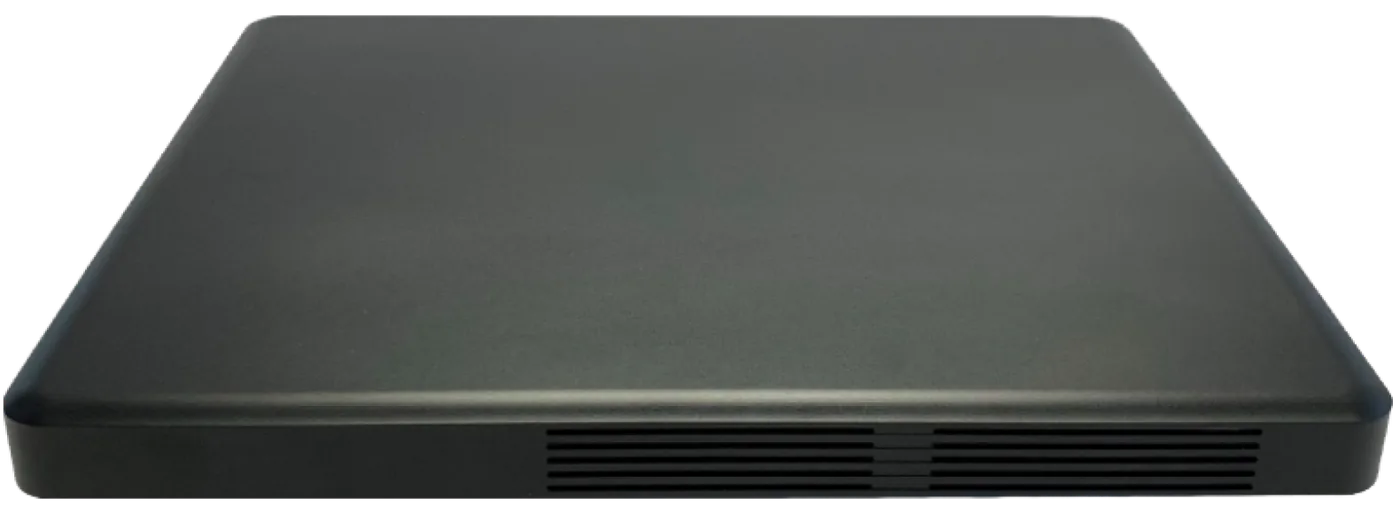
Power, Thunderbolt, transducer. That is the whole setup.
Our advice to a developer: buy an Intel i7 laptop with Thunderbolt 3, add our Application Programming Interface, and connect the XR. It ships with our Clinical Ultrasound Program for reference, supporting B-mode, M-mode, pulse-wave Doppler, colour flow Doppler, compression elastography, photoacoustics, harmonic imaging, a patient database, 10-second cine and continuous recording.
- 12 V DC power from an IEC 60601-1 desktop supply
- Thunderbolt 3 to the developer's PC, converted internally from PCIe
- Industry-standard transducer connector; curved linear, linear and phased arrays available
Everything is programmable
The API is written in C# with a C++ wrapper so developers can write their own graphical user interface and control the operation and style of the system.
- Transmit
- +HV, −HV, ground and high impedance on every channel; 512 delay profiles and 512 waveform profiles at 6 or 4 ns granularity, applied independently to each element
- Beamformers
- Eight, acquiring acoustic lines simultaneously
- Raw data
- RF from each beamformer or from each element's channel; 14-bit per channel, 20-bit beamformed, 16-bit enveloped acoustic line amplitude
- Digitization
- 40 or 60 MHz
UltraVision XR at a glance
- Front end
- 64 channels of 14-bit, 60 MHz analog-to-digital conversion connected to a single large FPGA
- Memory
- 4 GB DDR3 on the console
- Interface
- PCIe, presented to the PC as Thunderbolt 3
- Host PC
- 7th-generation or later Intel i7 with GPU and Thunderbolt 3, Windows 10 or 11
- Diagnostics
- Window showing all voltages and temperatures, element-by-element transducer test and a 64-channel oscilloscope mode resolvable to one clock and one amplitude level
- Software
- Clinical reference program, C#/C++ API, DirectX image formation, SQL patient database with DICOM output
- Size and weight
- 14×9.5×1.25 inches, 3 lb
- Power
- 12 V DC
- Regulatory
- Research and development platform built on the cleared UltraVision electronics; ISO 13485:2016 manufacturer
- Warranty
- Five years
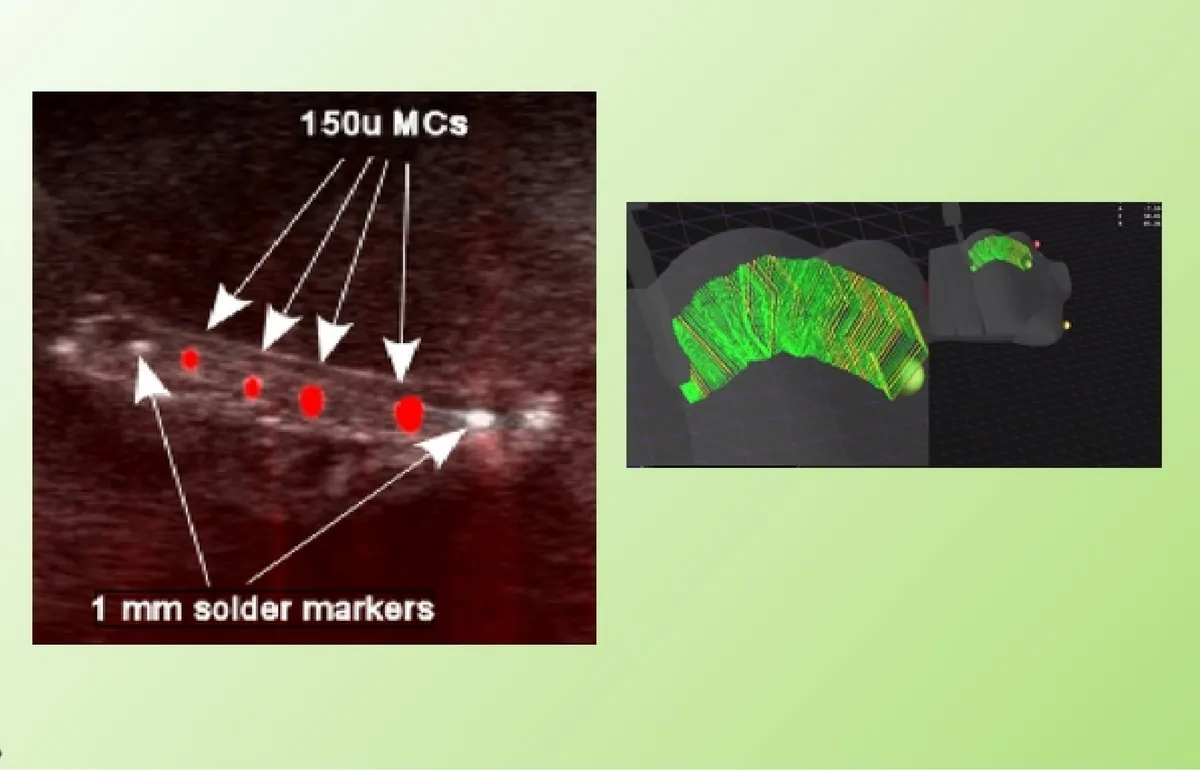
Develop on the PC, deploy in the FPGA
In the clinical platform the algorithms that produce each mode are shared between the CPU, the GPU and the FPGA. Developers create new algorithms from the RF or acoustic-line data in the CPU and GPU, and when they are perfected the UltraVision engineers instantiate the high-speed components in the FPGA for real-time operation.
The XR differs from, and is not promoted as, a pure research platform. If a custom algorithm can be specified in pulser phase, frequency and delay, it is usually quicker for the UltraVision team to implement it from the system's extensive capabilities than for the developer to start from scratch.
The research platform and areas of workStart your ultrasound product on a cleared platform
Tell us about the product you have in mind. We can supply the XR, the API, transducers and regulatory guidance.