
Put UltraVision inside your product
The UltraVision may be purchased as a component for a qualified original equipment manufacturer's product, to build ultrasound capability into their products, concepts and markets. We call these design and supply agreements Industry Partnerships or OEM agreements.
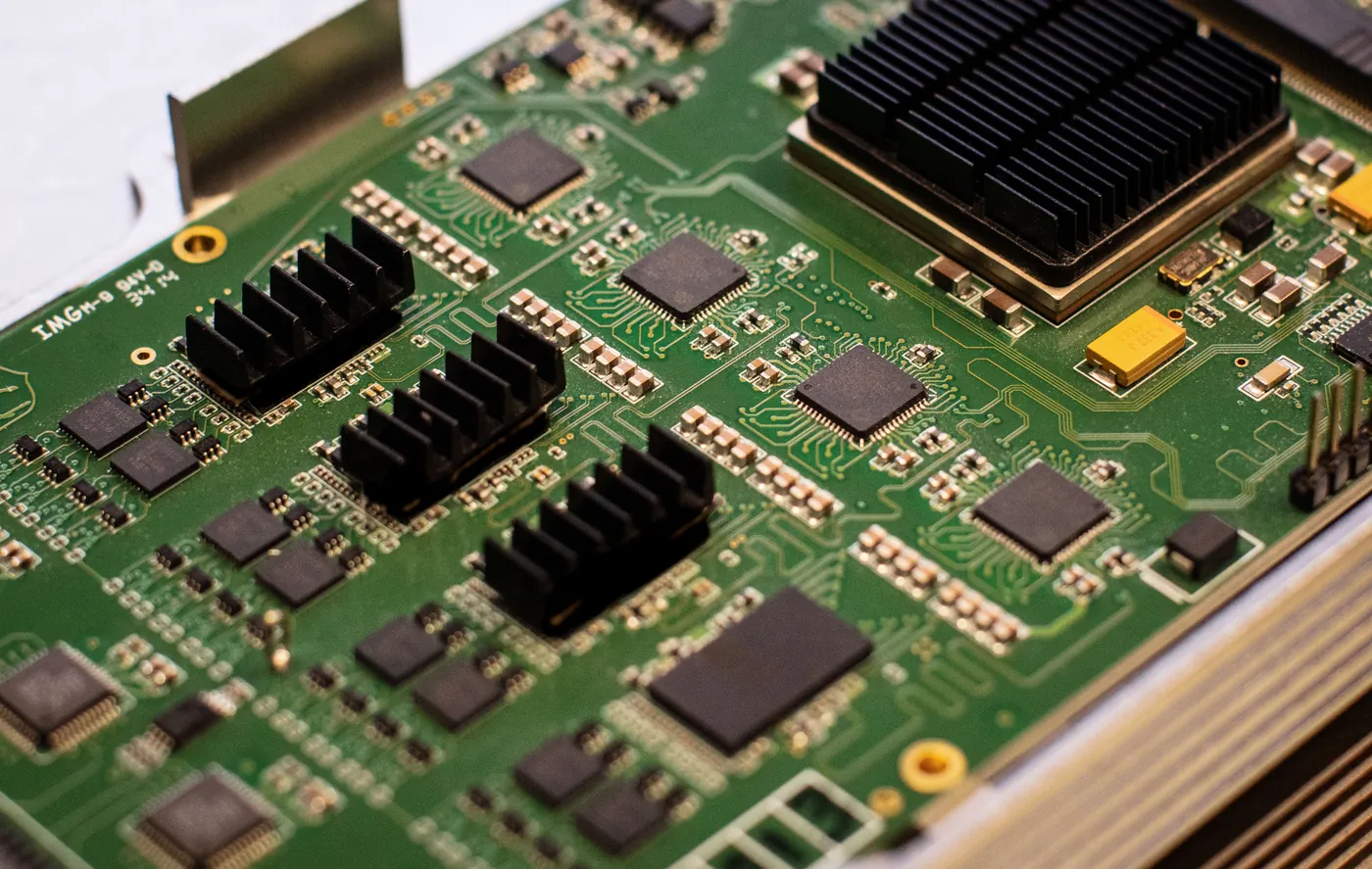
Four ways to build on the platform
Simplified and cleared
Functionality simplified and restricted in acoustic power output and modes so a physician or sonographer can use it easily. Conforms to an existing FDA 510(k) held by UltraVision.
Fully open
Transmit power, modes and virtually any function can be evaluated and optimized, which is its intended use, before submitting for regulatory approval.
Boards and components
Components of the UltraVision that the partner assembles into a marketable system, with monitors, PC, case and battery supply as required.
Your own interface
A C++ or C# Application Programming Interface so the OEM can program their own graphical user interface or a specific ultrasound process.
Partnership models
- We design a product to evaluate a concept, as in many government grants
- We build production quantities indefinitely, a single unit or a preproduction run
- We design the product, then transfer the technology for a license fee or a one-time buyout
- The partner produces any or all components under license; keys in the system control the licensing
- The partner may choose not to relabel and proceed to market under UltraVision's regulatory approvals
- Non-competing franchise agreements for specialties and territories
Support and services
- Software products come with 25 hours of online or telephone support; further 25-hour blocks at reasonable prices
- Online demonstrations, and specific images created for the OEM's area of interest
- Transducer test facility: acoustic output measured and added to our transducer device file, usually within weeks of receiving three identical transducers
- Experience and relationships with approved laboratories for RF emissions and susceptibility testing
- Remote operation and field support over Windows remote-control tools
A small selection of boards, all programmable
Usually three boards plus a transducer interface implement a system: UP1 (9×3.5 in), UP2 (9×2.5 in) and UP72 (4.6×3.8 in). The pulsers and receivers connect to the transducer elements through multiplexers controlled by programmable devices, and the main processing board connects every channel to one very large FPGA, programmed in VHDL and normally reserved for UltraVision to supply whatever changes the OEM requests.
- Programmable from Thunderbolt 2, 3 or 4, or PCIe
- 9 to 19 V DC at 4 A, from an IEC 60601-1 desktop supply (90 to 264 V input) or the battery option
- Power supply board converting the input to multiple low-noise rails
- Central controller: an Intel i7 as a compact NUC over PCIe (as in the XS), a user-supplied PC over Thunderbolt, or a Microsoft Surface Pro
- Power sequencer (Arduino format) controlling rails, battery monitors and the 3D/4D stepper; multi-transducer switch on an MSP430; both updatable over USB
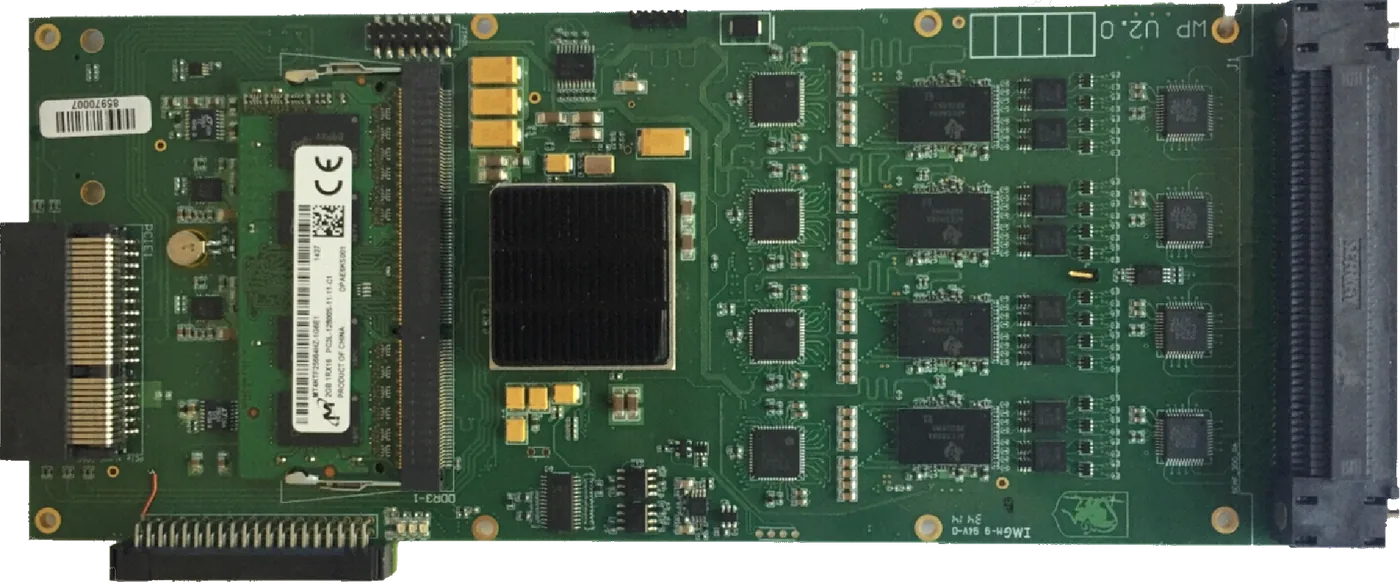
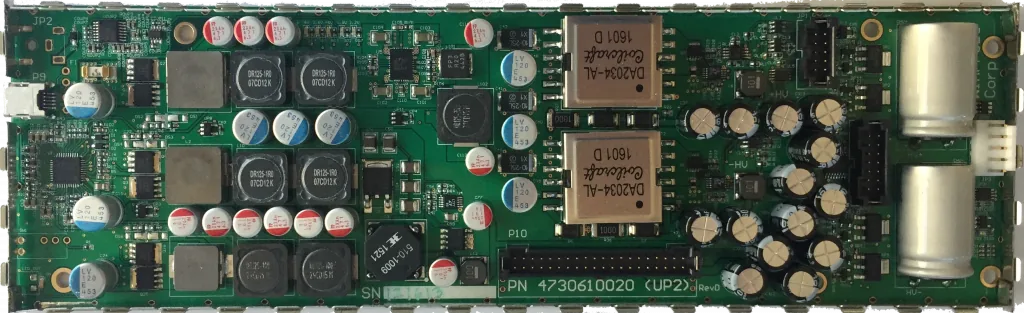
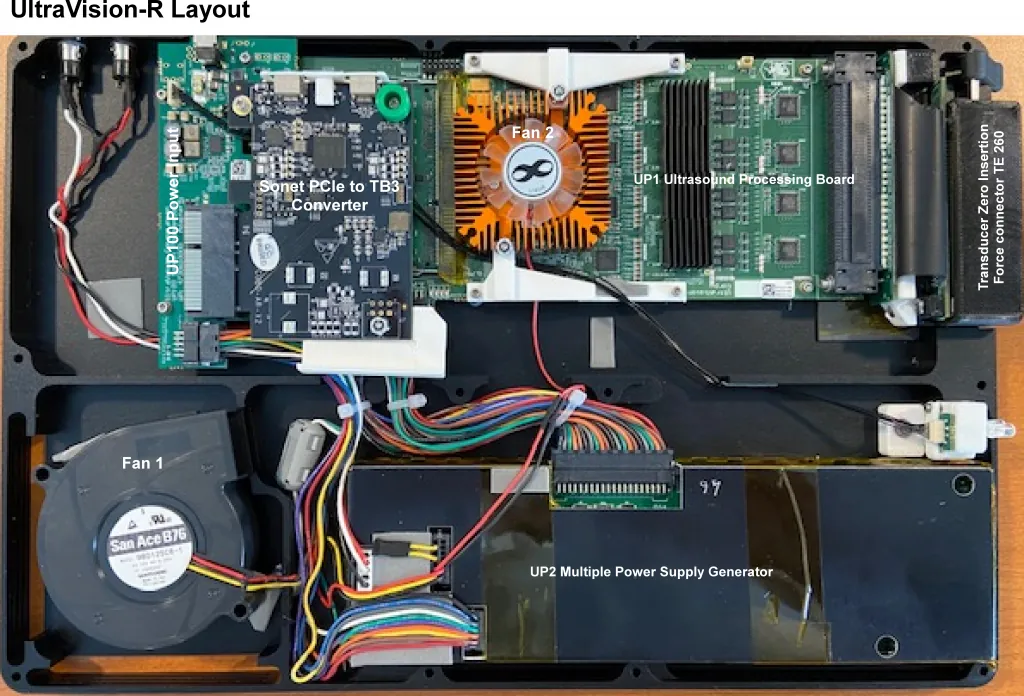
Everything from the touch screen to the FPGA
Clinical GUI
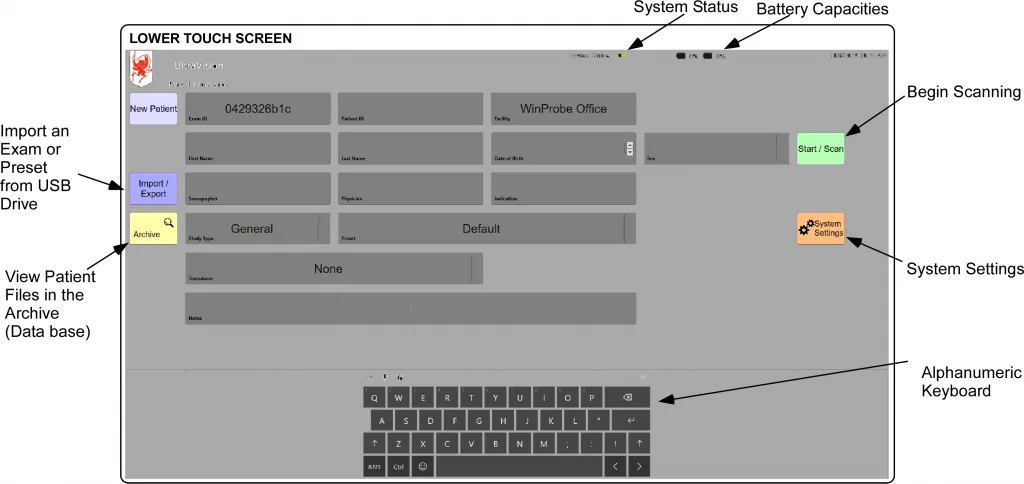
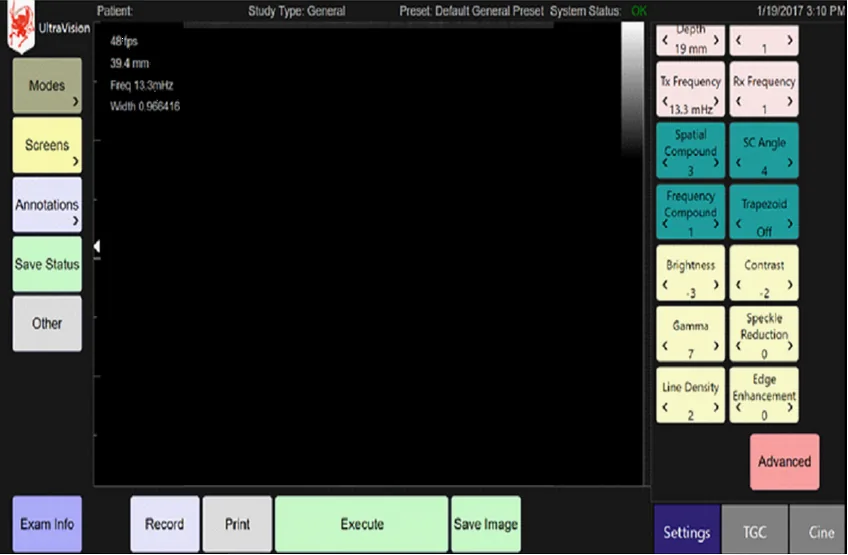
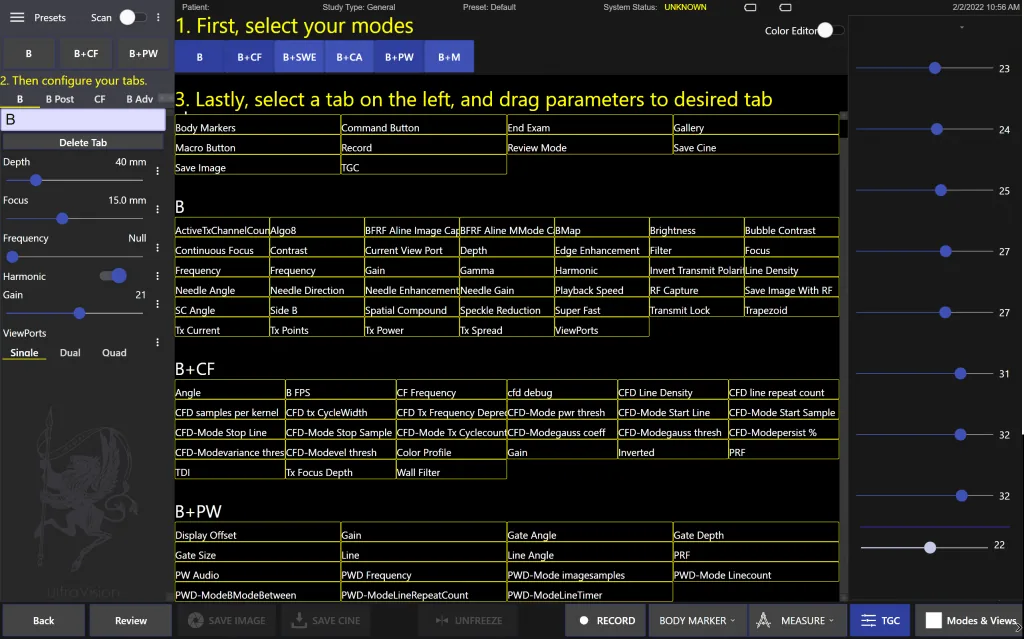
A touch-screen graphical user interface written in C# and Windows Presentation Foundation, with a user manual in English. As a clinical platform the distributor chooses which options ship in the basic system and which are sold as extras.
API and sample application
A C++ interface to adapt new hardware and transducers and accommodate different languages and GUI designs, with sample application source in WPF for the C# designer.
View DX
For the designer familiar with DirectX 11 or 12: accepts digital acoustic lines from the console and creates real-time images with B, M, colour flow, pulse-wave Doppler, elastography, photoacoustics and caliper functions.
Patient and session management
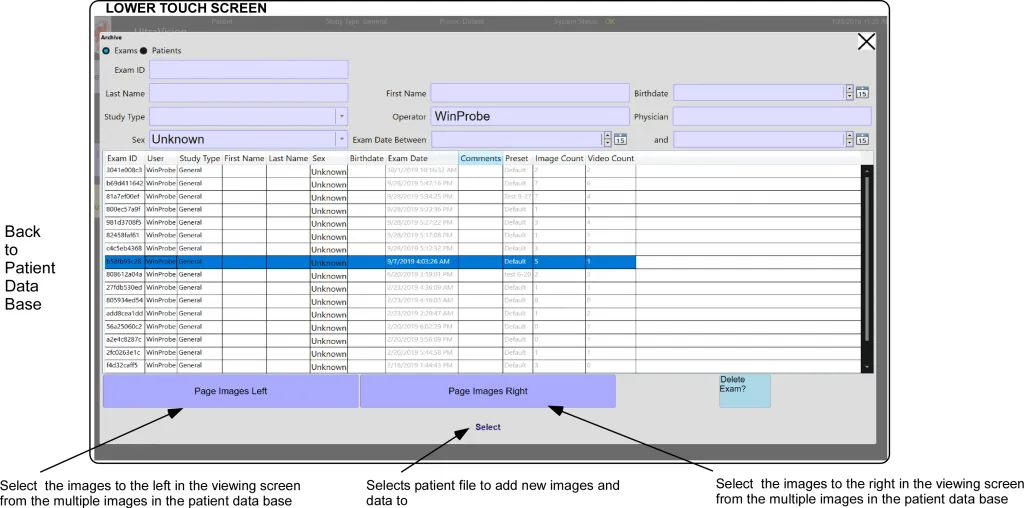
Packaged, licensed programs with an SQL patient database where demographics and images are archived and edited, and DICOM-compatible output. Windows-based logins let the OEM pass administration to the customer.
Updates and diagnostics
All software, including the power sequencer, the FPGA and smart transducers, is reprogrammable from the PC under the Diagnostics menu, from a USB stick or our server. Registers, voltages and temperatures are visible for remote service.
Transducer definitions
An XML file lets the OEM edit transducer characteristics, including pitch and geometry (linear, curved, phased, micro-curved, origin), and operate the system with any transducer design within minutes. The system ships with a deployment USB stick holding all software, drivers and the Windows license.
Cleared platform, compliant manufacturer
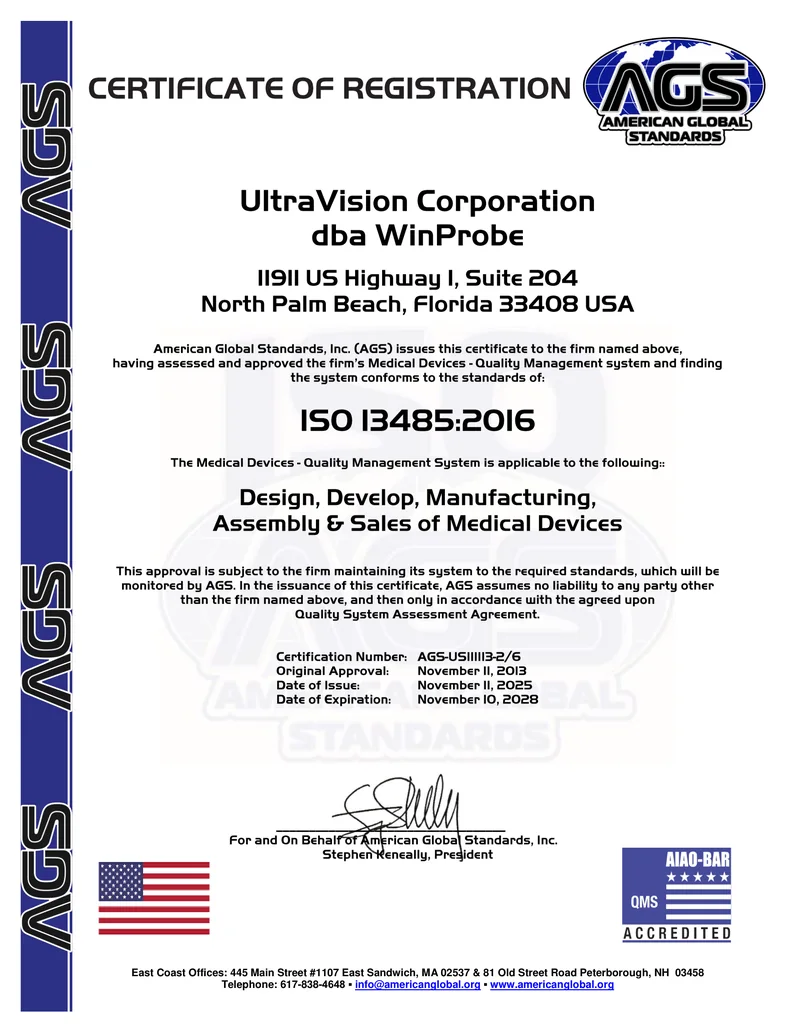
The UltraVision product has FDA 510(k) clearance and UltraVision is an ISO 13485:2016 compliant company. The indications for use covered by our 510(k) submissions are small parts (breast, testis and thyroid), superficial musculoskeletal, abdominal and peripheral vessels.
Modifications by the developer, or a different use case, may invalidate the 510(k) and require the developer to resubmit. Labeling changes, a change of intended use or technology performance changes require the OEM to file a 510(k), where we stand ready to assist on a consulting basis. A new transducer needs only an acoustic measurement placed in the design file unless it brings a new indication for use.
- Guidance on the programmable electrical medical systems requirements of IEC 60601-1: software requirements, design, verification and validation
- ISO 13485 quality system available to the OEM when the product label carries the UltraVision GUDID
- Clearance letters available to qualified OEMs on request; the ISO certificate is on our certifications page
Let us build the ultrasound part
We have not, and do not, supply competing commercial products to the same market. With more than 200,000 new ultrasound systems sold each year across specialties, there is room for your product.